How Experienced Rockery Contractors Handle Difficult Slopes
If your yard has a steep hill, uneven ground, or soil that seems to shift every time it rains, experienced Rockery Contractors can turn that difficult slope into one of the most useful and attractive parts of your property. Sloped yards can be tricky for homeowners because they often deal with erosion, drainage problems, limited usable space, and unsafe walking areas. But with the right planning, materials, and rock wall construction methods, a steep landscape can become strong, stable, and beautiful.
For many homeowners, the first thought is to flatten everything out. That sounds simple, but with slopes, the better solution is often to work with the natural grade instead of fighting against it. This is where professional rock landscapers make a big difference. They understand how to use rockwalls, landscape boulders, retaining walls, and natural stone placement to control soil movement while creating a landscape that feels like it belongs there.
Why Difficult Slopes Need More Than Basic Landscaping
A difficult slope is not just a design challenge. It is a structural challenge. When rainwater runs downhill, it carries soil with it. Over time, that can cause washed-out planting beds, exposed roots, muddy areas, sinking patios, and pressure against fences, driveways, or foundations. In the Puget Sound Area, where wet weather is part of the rhythm of life, slope issues can show up quickly if the yard is not properly supported.
Basic landscaping may help the surface look better for a while, but mulch, plants, and small edging usually will not solve deeper slope problems. A steep yard needs structure. That structure often comes from rock walls, retaining walls, drainage planning, and carefully placed landscape boulders that help hold soil in place.
Experienced Rockery Contractors look at more than what is visible on the surface. They consider the grade of the land, soil type, water flow, access for equipment, surrounding structures, and how the finished yard will be used. That full-picture approach is what separates a lasting rockery project from a temporary fix.
Step One Is Understanding the Slope
Before any rock wall construction begins, a skilled rock wall contractor will study the slope. This includes looking at how steep the grade is, where water naturally travels, and where the soil is already showing signs of movement. Some slopes need one strong retaining wall. Others work better with multiple smaller rock walls that create terraces.
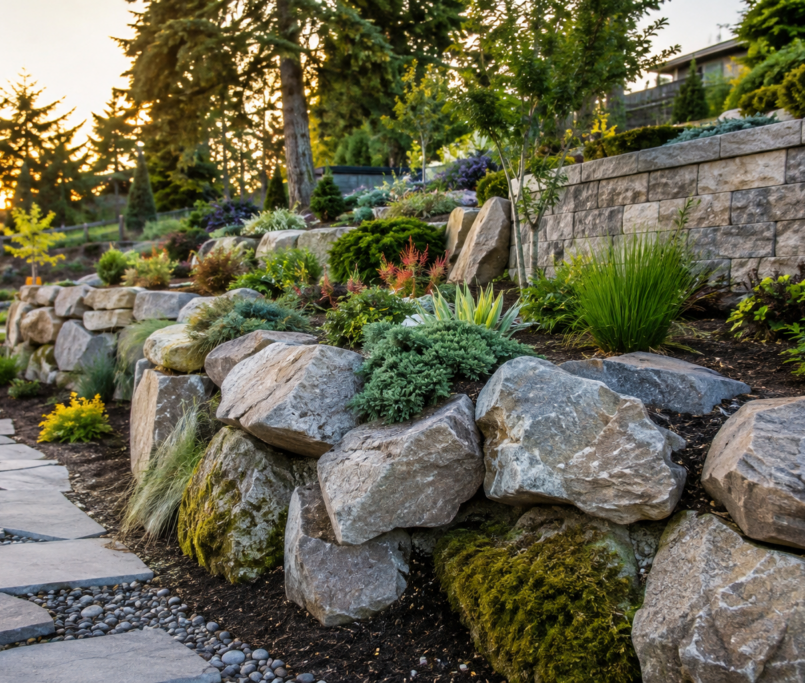
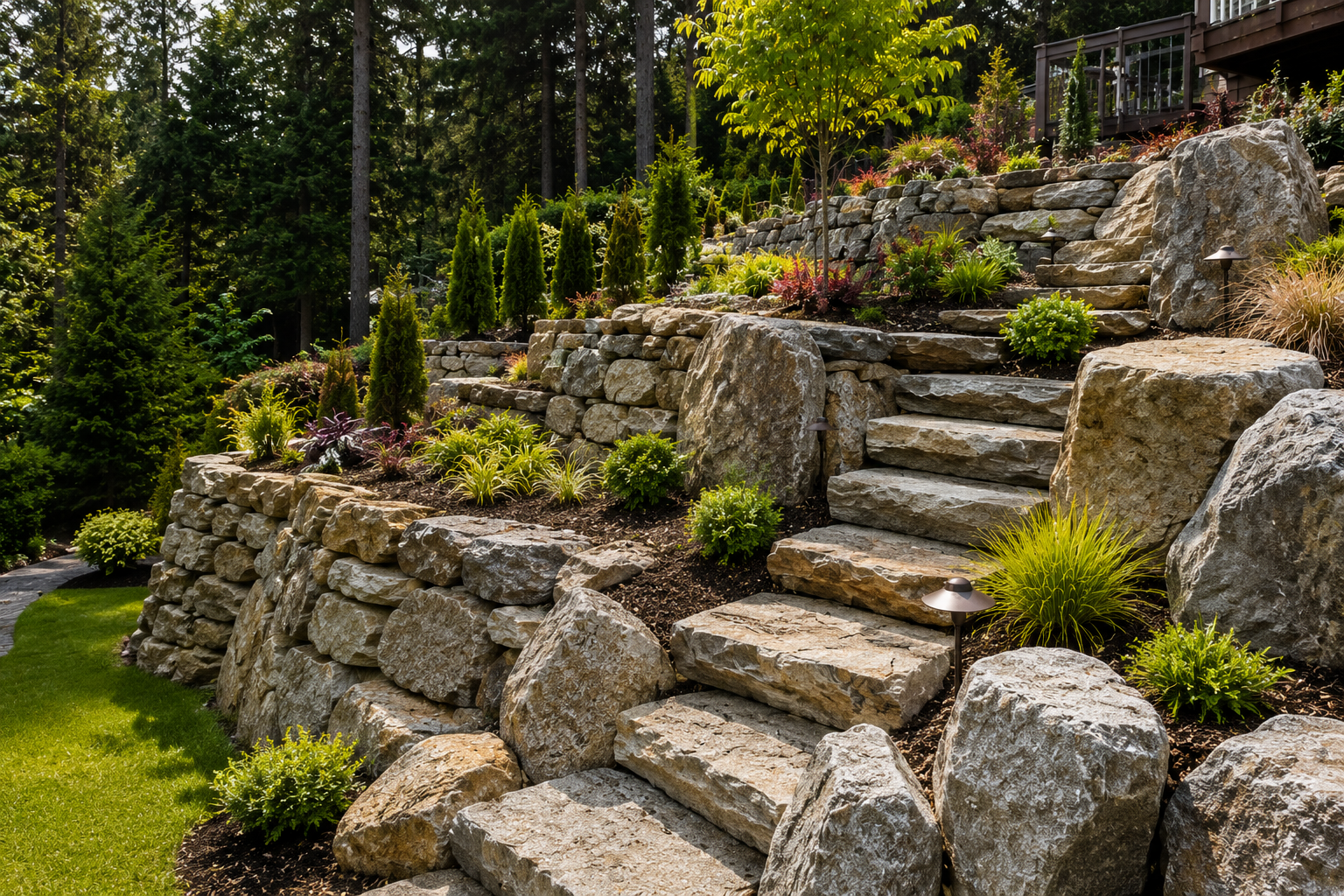
Terracing is often one of the best ways to handle a steep yard. Instead of one tall wall holding back a large amount of soil, several shorter walls can divide the slope into usable levels. This helps reduce pressure on each wall while making the yard more functional. A hillside that once felt unusable can become garden space, a sitting area, steps, pathways, or planting zones.
This is where rock wall landscaping becomes both practical and creative. A good rock landscaper can look at a sloped yard and see opportunities that are not obvious at first. That awkward hill in the backyard might become a layered garden. A muddy side yard might become a stone stairway. A steep front slope might become a bold rockery feature that adds curb appeal.
Choosing the Right Landscape Boulders
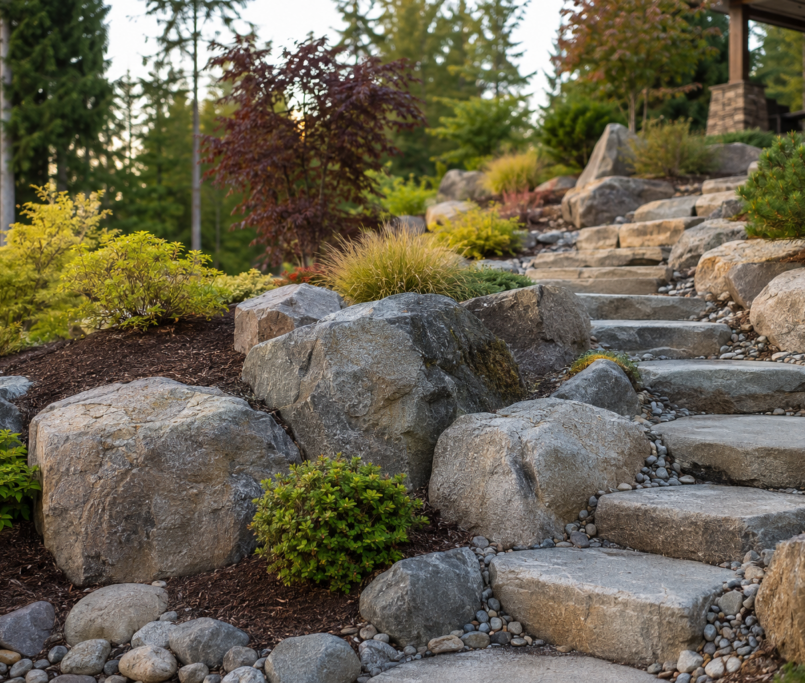
Not all rocks are the same, and not every stone is right for every slope. Experienced rock landscapers know how to choose landscape boulders based on size, shape, weight, durability, and how they will fit together. For structural rock walls, the stone needs to do more than look good. It needs to interlock, resist movement, and support the soil behind it.
Large boulders are often used at the base because they provide strength and stability. Smaller stones may be worked into upper areas or used for visual detail. The goal is to create a wall that looks natural but functions like a carefully built structure.
This is one reason hiring a professional rock wall contractor matters. A homeowner may be able to pick out beautiful stone, but knowing how to place each boulder so it supports the entire wall takes experience. It is a little like building a puzzle where every piece weighs hundreds or thousands of pounds. Not exactly a Saturday afternoon arts and crafts project.
Building From the Ground Up
A strong rock wall starts with a strong base. On a difficult slope, the base is one of the most important parts of the entire project. If the foundation is weak, uneven, or poorly prepared, the wall can settle, lean, or fail over time.
Professional Rockery Contractors typically begin by preparing the area, removing loose soil, and creating a stable foundation. Depending on the site, this may involve excavation, grading, compacted rock, and drainage materials. The first row of boulders is placed carefully because it sets the tone for the entire wall.
From there, the wall is built in a way that works with gravity. Rock walls are often slightly battered back into the slope, meaning they lean gently toward the soil they are holding. This helps the wall resist outward pressure. The stones are stacked and fitted so the weight of the wall helps lock everything into place.
A well-built rockery should feel solid, not forced. The finished result should look natural while quietly doing a lot of heavy lifting behind the scenes.
Drainage Is the Secret Hero
When homeowners think about retaining walls, they usually picture the stones first. But drainage is just as important as the rock itself. Water buildup behind a wall can create serious pressure. If that pressure has nowhere to go, it can push against the wall and cause bulging, leaning, or failure.
Experienced rock landscapers plan drainage before the wall is finished. This may include gravel backfill, drainage pipe, filter fabric, grading, or other solutions that help move water safely away from the wall. In areas like Seattle, Bellevue, Kirkland, and Redmond, proper drainage is especially important because wet soil can become heavy fast.
Good drainage also protects the rest of the yard. Instead of water rushing down the slope and carving out channels, a properly designed rockery can guide water in a controlled way. This helps protect planting areas, patios, lawns, driveways, and nearby structures.
Creating Usable Space on a Sloped Yard
One of the biggest benefits of rock landscaping on a slope is the ability to create usable outdoor space. Many homeowners look at a steep yard and assume there is not much they can do with it. But rock wall landscaping can completely change how the property functions.
Retaining walls and terraces can create flat areas for gardens, seating, pathways, fire pits, or outdoor living spaces. Stairs can be built into the slope to make movement safer and easier. Landscape boulders can also be used as natural seating, borders, or visual anchors.
Instead of one steep drop-off, the yard becomes a series of intentional spaces. This makes the landscape feel larger, more organized, and easier to enjoy. It also gives the property a custom look that basic flat landscaping often cannot match.
Making Rock Walls Look Natural
The best rock walls do not look like they were forced into the yard. They look like they belong there. That is one of the reasons natural stone is so popular for sloped landscapes. It blends well with plants, trees, soil, and the Pacific Northwest environment.
An experienced rock landscaper will think about the overall design, not just the structural wall. They may consider planting pockets, curves, stone color, boulder size, and how the wall connects with the rest of the property. Rock walls can be bold and dramatic, or they can be softer and more organic.
This is especially helpful for homeowners who want function without losing beauty. A retaining wall does not have to look like a plain barrier. With the right rock wall construction, it can become one of the most eye-catching features in the yard.
Handling Access Challenges
Difficult slopes often come with another challenge: access. Tight side yards, narrow driveways, trees, fences, utilities, and existing landscaping can all make construction more complicated. Professional Rockery Contractors know how to plan around these challenges.
Equipment access is a big part of the process. Moving large landscape boulders safely requires the right machinery and skill. On some properties, the contractor may need to use smaller equipment, adjust the construction sequence, or carefully stage materials to avoid damaging the rest of the yard.
This is one of those details homeowners do not always think about until the project starts. Getting boulders into the backyard can be just as important as stacking them once they are there. A good contractor plans the path before the first stone is moved.
Preventing Future Erosion
A rockery should not only solve today’s slope problem. It should also help prevent future issues. That means thinking about how the slope will behave during heavy rain, seasonal changes, and long-term settling.
Erosion control may include retaining walls, proper grading, drainage, groundcover plants, and strategic boulder placement. Plants can help stabilize surface soil, while the rock walls provide the deeper structure needed to hold the slope. Together, they create a more complete solution.
This layered approach is especially valuable for homeowners who have dealt with repeated washouts. Instead of replacing mulch or repairing the same muddy area every year, a well-planned rockery can give the slope the support it has been missing.
When a Slope Needs a Professional Rock Wall Contractor
Some small landscape projects are fine for DIY. Difficult slopes are usually not one of them. When soil retention, drainage, heavy boulders, and property protection are involved, it is worth bringing in a professional rock wall contractor.
You should consider hiring a pro if your slope is steep, if soil is washing away, if water collects near your home, if an old wall is leaning, or if you want to create usable space on a hillside. It is also smart to get expert help if large boulders or structural retaining walls are part of the plan.
A professional can help you avoid common mistakes, such as using stones that are too small, skipping drainage, building on an unstable base, or creating a wall that cannot handle the pressure behind it.
Rockery Contractors Bring Strength and Design Together
The best Rockery Contractors understand that slope work is part engineering, part craftsmanship, and part landscape design. The wall needs to hold. The drainage needs to work. The stone needs to fit the property. And the finished yard needs to look like something you actually want to spend time in.
That balance is what makes rock wall landscaping such a smart choice for difficult slopes. It gives homeowners a durable way to manage elevation changes while adding natural character and long-term value to the property.
Whether you are dealing with erosion, a steep backyard, a failing wall, or a hillside that feels impossible to use, rockwalls and retaining walls can completely reshape the space. With the right plan, your most frustrating slope can become one of the strongest and most beautiful parts of your landscape.
If you are planning rock landscaping in Seattle, Bellevue, Kirkland, Redmond, or anywhere in the Puget Sound Area, Olympic Rockery & Landscape Supply, LLC can help turn a challenging slope into a stable, functional, and beautiful outdoor space. From landscape boulders and rock walls to retaining walls and full rock wall landscaping, their team can help you plan the right solution for your property. When you are ready to get started, Request an Estimate and take the first step toward a stronger, better-looking yard.